Loading page
Loading


Product catalogue
Cells, conversion and copper. Storage from a 5 kWh wall pack to a 125 kWh cabinet, a 5 kW single-phase hybrid inverter, a pole-mount battery for sites with no floor to spare, and LV assemblies built to your schedule. The engineers who specify this hardware are the ones who commission it on site.
Read from the product data on this page. Where a figure and a datasheet disagree, the datasheet wins.
Which one
Most people arrive with a building and a problem rather than a capacity in mind. Pick the situation that sounds like yours; the figures are underneath.
The two residential packs and the industrial cabinet, against the fields a buyer actually decides on. The pole-mount system is in the table because it competes for the same jobs on sites with no floor — its dimensions and weight cover both of its cabinets.
Scroll the table sideways to compare.
| Specification | Rated energy 5kWh 5 kWh wall pack BL05 | Rated energy 16kWh 16 kWh floor pack BL16 | Rated energy 125kWh 125 kWh cabinet BH99 | Rated energy 96kWh Pole-mount pack BP10 |
|---|---|---|---|---|
| Suited to | A first solar system on a house. One pack on the wall now, a second on the same bus later rather than a bigger one bought today. | Whole-house backup and light-commercial load shifting, standing on the floor of a plant room or a garage. | A commercial or industrial site shaving a demand peak, or riding an outage through on three phases. | A low-voltage feeder with no land to give up: peak shaving, voltage support and solar reverse flow, from an existing concrete pole. |
| Usable energy | 4.5 kWh | 14.46 kWh | — | 96 kWh |
| Rated power | — | — | 100 kW | 40 kW |
| Nominal voltage | 51.2 V | 51.2 V | 768 V | 51.2 V |
| Cell chemistry | LiFePO4 | LiFePO4 | LiFePO4 | LiFePO4 |
| Cycle life | 6,000 cycles | 4,000 – 6,000 cycles | — | 4,000 cycles |
| Max charge current | 100 A | 150 A | — | — |
| Max discharge current | 100 A | 200 A | — | — |
| Units in parallel | Up to 16 | Up to 16 | — | — |
| Round-trip efficiency | 97 % | 98 % | 90 % | 89.8 % |
| Dimensions (L × W × H) | 690 × 380 × 148 mm | 920 × 500 × 250 mm | — | Battery 1305 × 569 × 1394 · PCS 1003 × 702 × 902 mm |
| Weight | 49.3 kg | 120 kg | — | 1150 kg |
| Mounting | Wall mount | Stand-alone | — | Single concrete pole, bolts or pole straps supplied |
| Environment | Indoor | Indoor | Indoor or outdoor | Outdoor |
| Enclosure rating | — | — | IP55 | IP55 |
| Cooling | Natural cooling | Natural cooling | Forced air, circular duct | Integrated cabinet air-conditioning |
| Status | Published specification | Published specification | Published specification | Published specification |
| Specification | Full specification for the 5 kWh wall pack | Full specification for the 16 kWh floor pack | Full specification for the 125 kWh cabinet | Full specification for the Pole-mount pack |
Every figure is read from the product data behind the specification pages. A dash means that unit does not publish the field yet — ask and we will send what exists. Size the system on usable energy; rated energy is the nameplate figure before depth of discharge.
Published specification
Sizing storage is one decision made twice: how long the building has to keep running without the grid, and how much of your own generation you want to keep instead of export. Three sizes of that problem — a wall pack, a floor pack and a cabinet — on the same chemistry and the same BMS discipline.
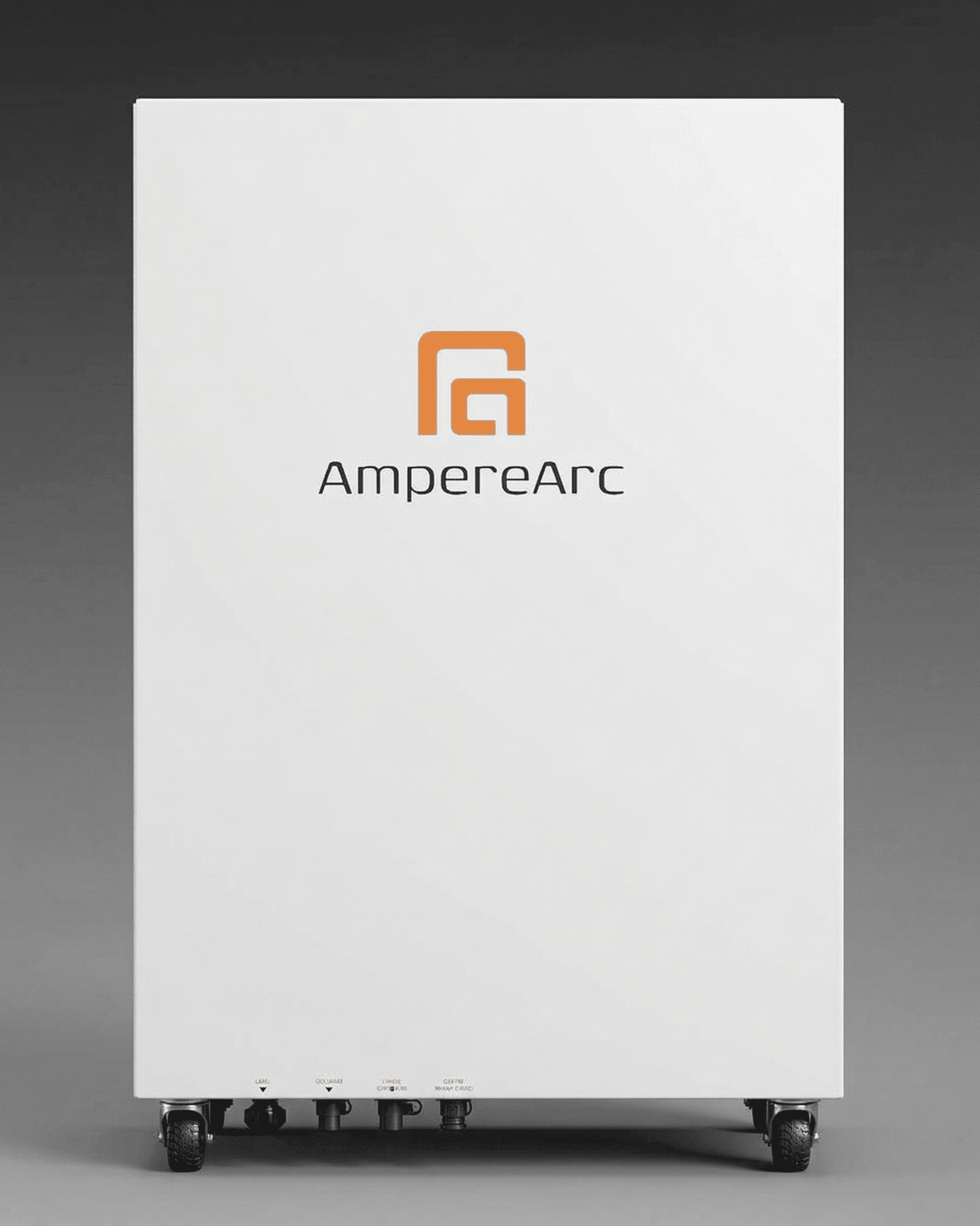
Rated energy
5kWh
A first solar system on a house. One pack on the wall now, a second on the same bus later rather than a bigger one bought today.
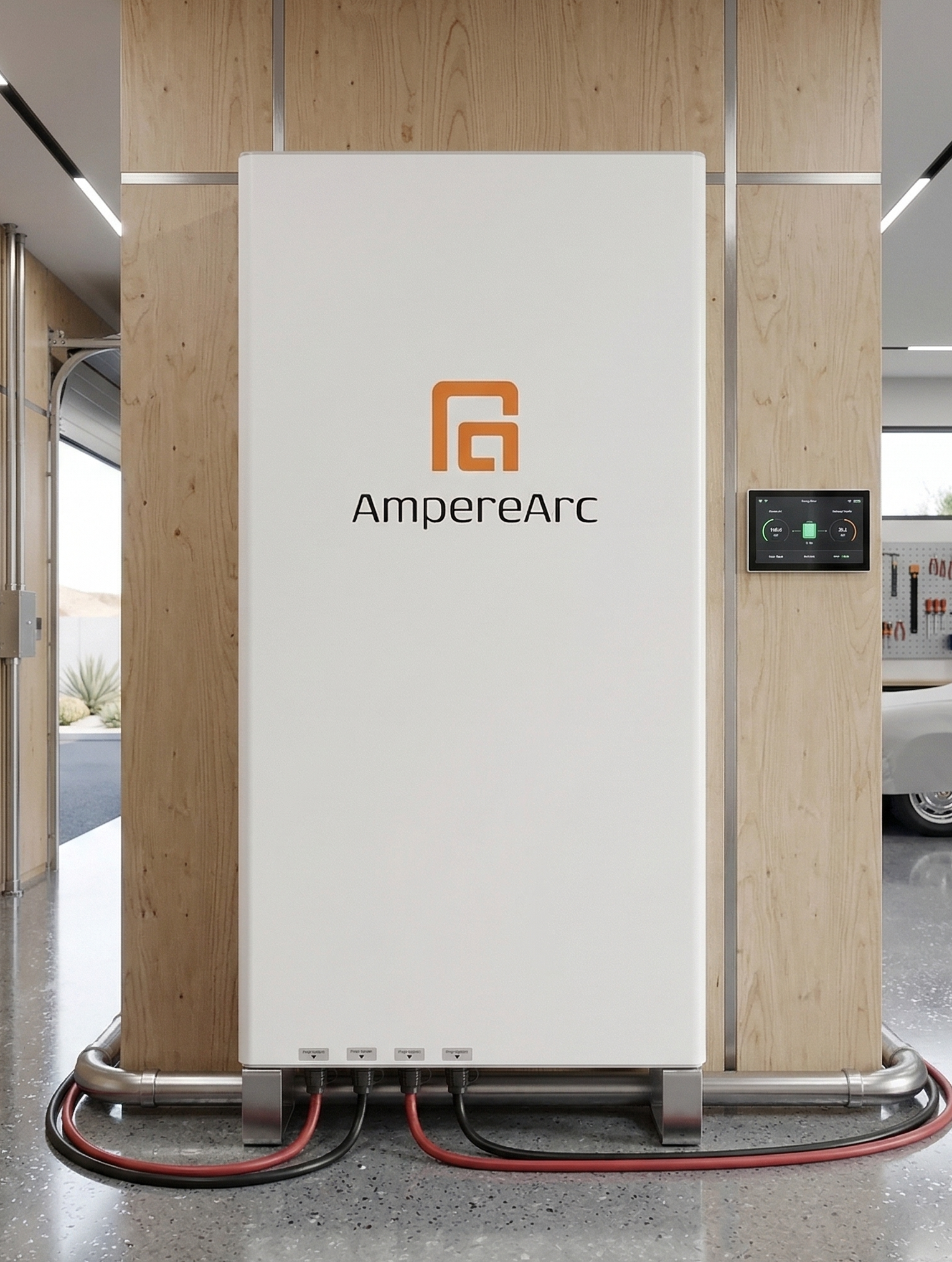
Rated energy
16kWh
Whole-house backup and light-commercial load shifting, standing on the floor of a plant room or a garage.
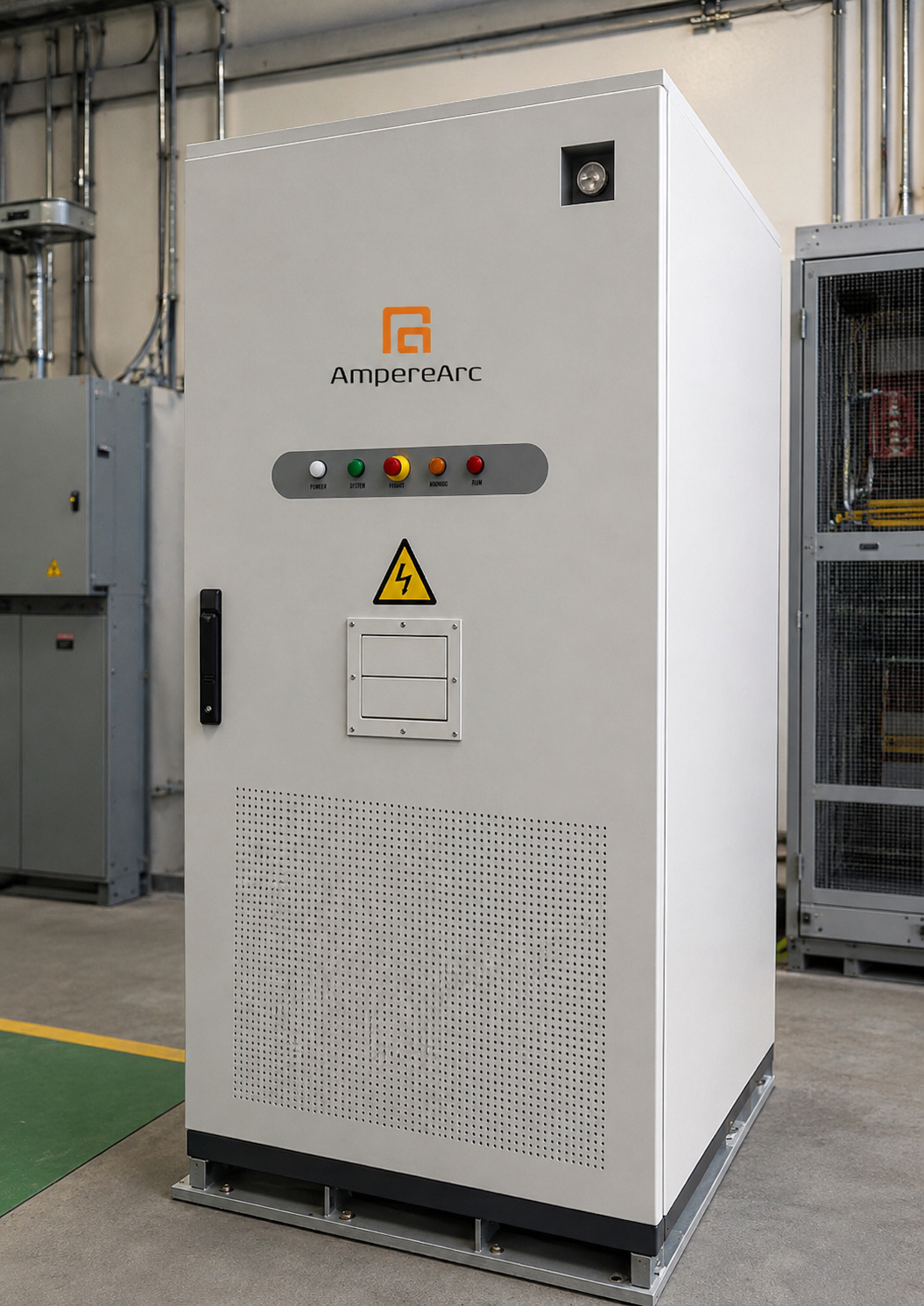
Rated energy
125kWh
A commercial or industrial site shaving a demand peak, or riding an outage through on three phases.
The engineers who specify the pack are the ones who commission it. The survey reads the incomer and the half-hourly data before anything is sized, the grid application goes in at design stage rather than after delivery, and the system runs under load with your people in the room before it is signed off.
Design, supply, installation and commissioning for battery storage, solar and EV charging — grid application and panel work included.
Backup circuits that stay live during an outage
Published specification
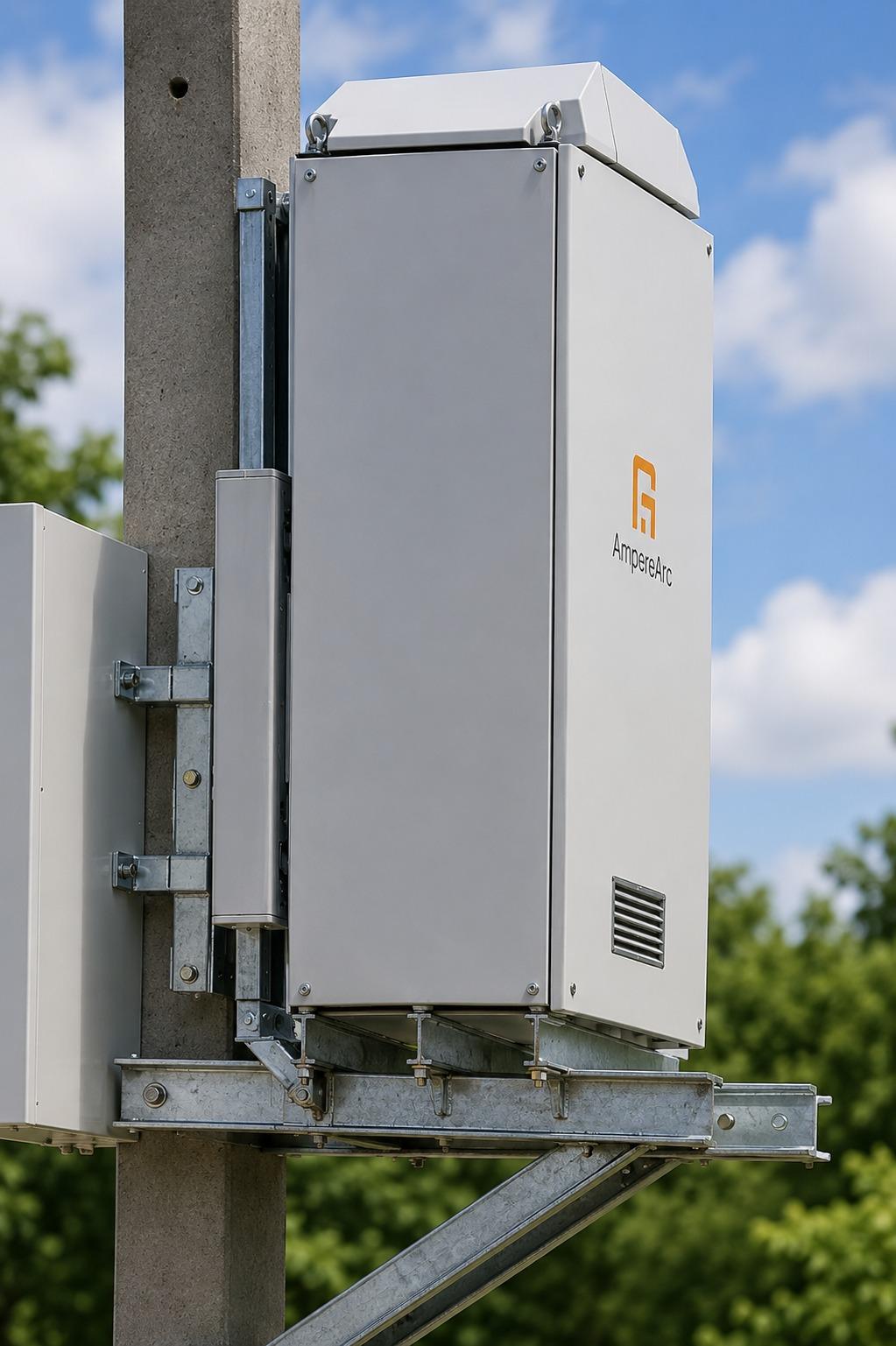
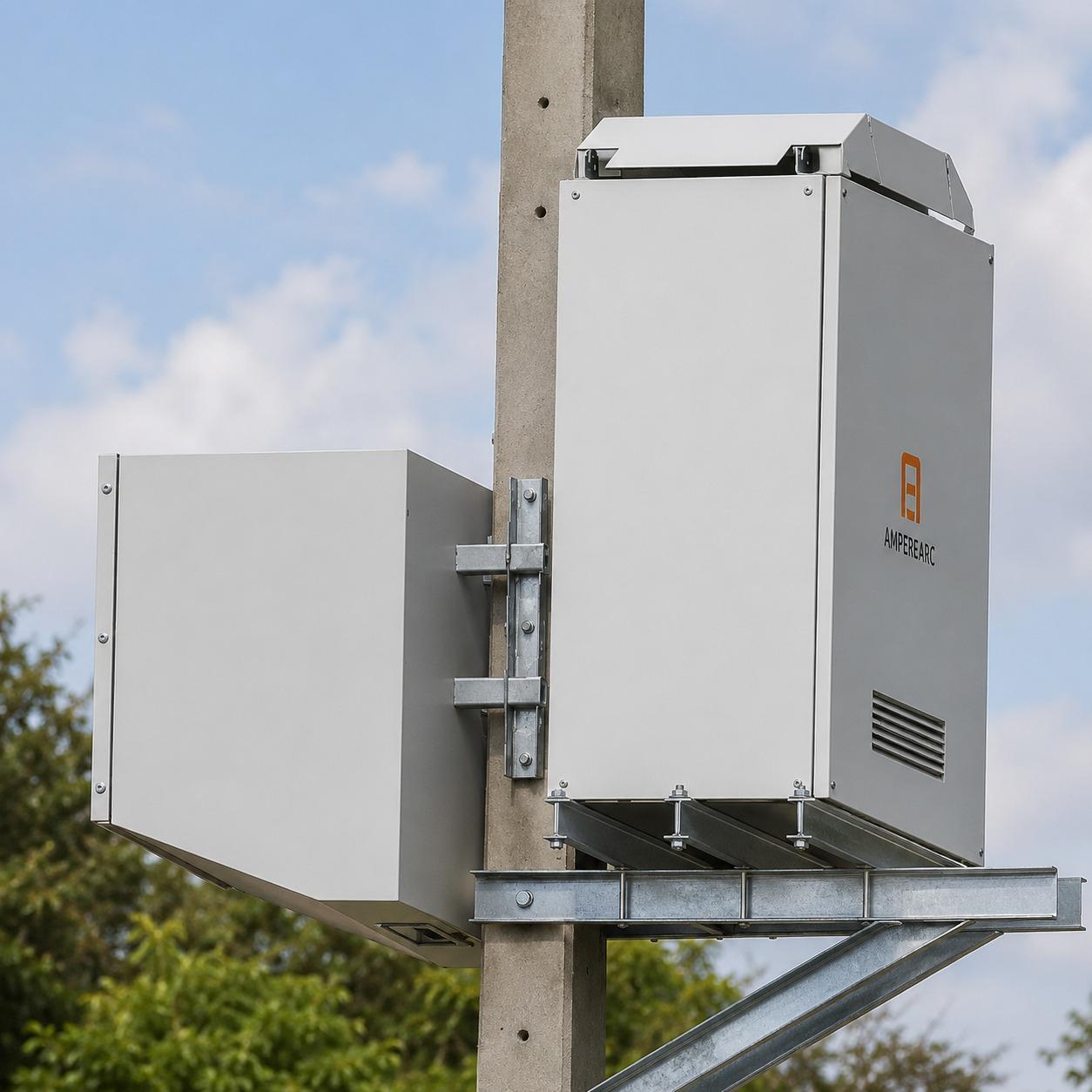
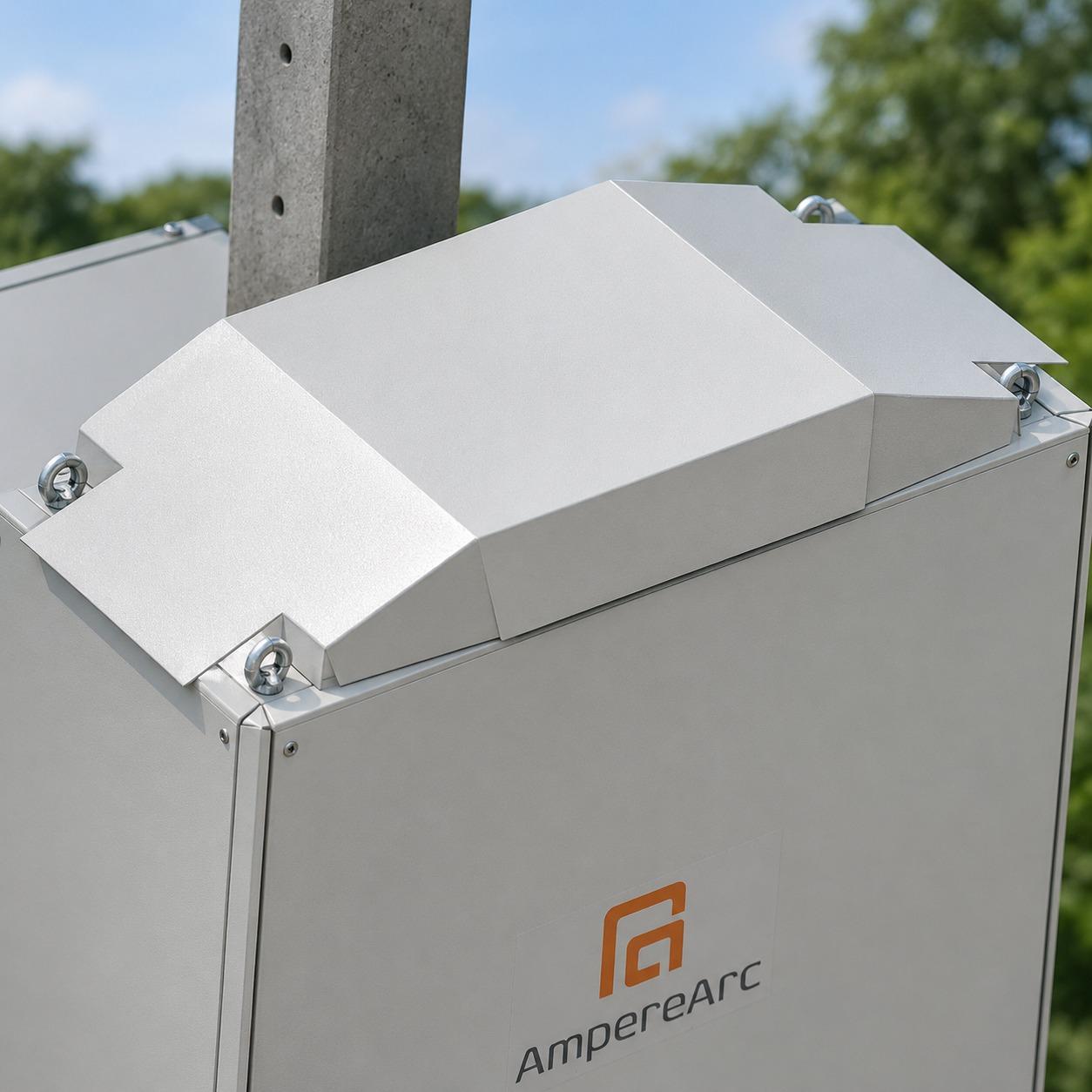
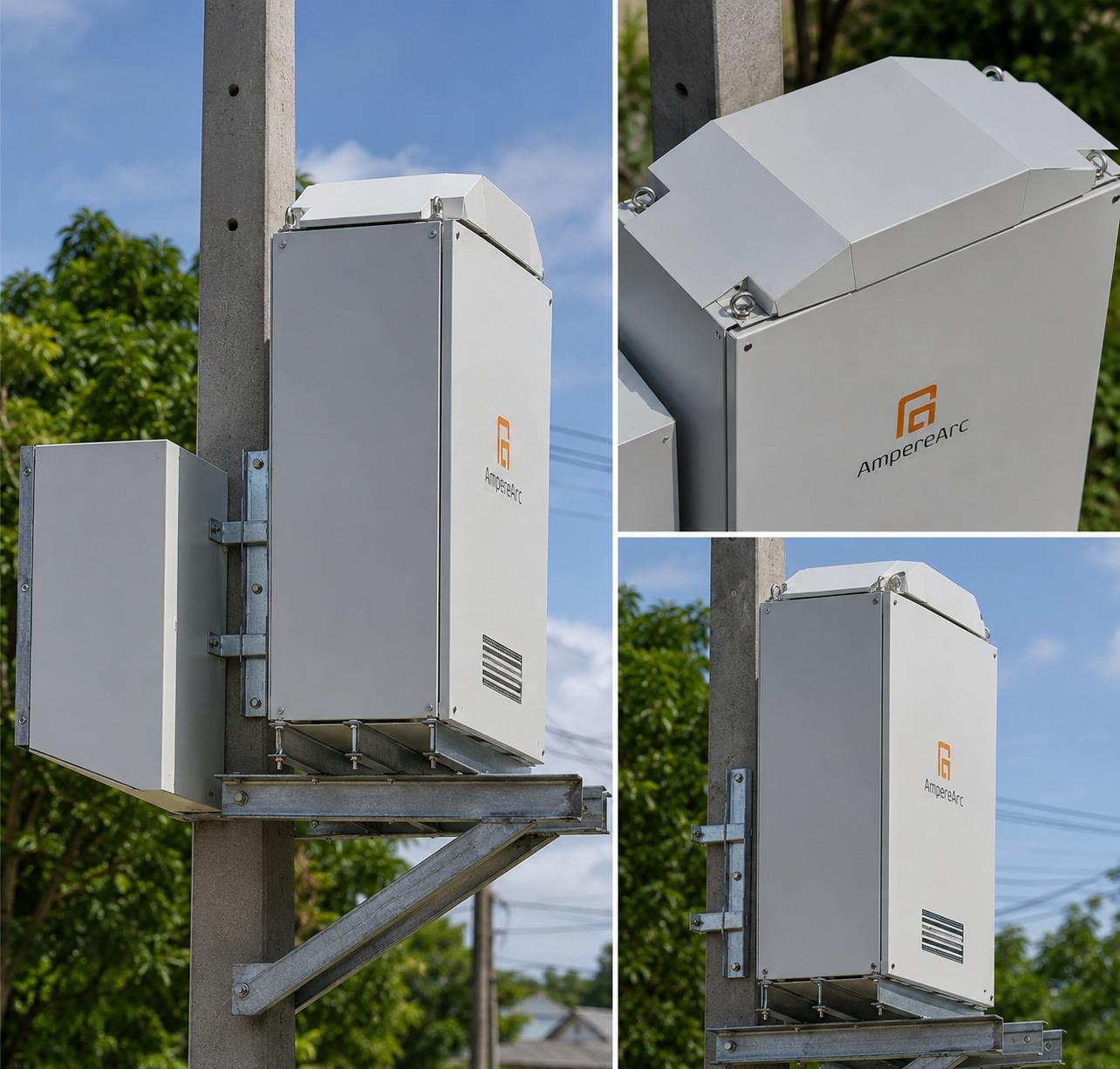
Every other pack in this catalogue needs a floor, a wall or a hardstanding. This one needs a concrete pole that is already standing — which is the whole point on a feeder or a street where there is no land to lease.
Rated energy
96kWh
Distribution-network storage that goes on a single concrete pole instead of a plot of land: 40 kW / 96 kWh of LiFePO4 on a 400 V three-phase, four-wire connection, split between a battery cabinet and a PCS/control cabinet that bolt or strap to an existing pole. Integrated air-conditioning, IP55 enclosures hot-dip galvanised and painted for an exposed, polluted coastal atmosphere, and aerosol fire suppression with automatic battery isolation from the BMS. Four-quadrant P and Q control for peak shaving, Volt-VAr voltage support and absorbing solar PV to curb reverse power flow, controlled remotely over Modbus or DNP3 through Ethernet or the factory-fitted cellular modem.
Read from the published datasheet. Where this page and the PDF disagree, the datasheet is correct.
A battery on a pole is still a grid connection. Every installation runs through the same three steps as everything else here, and the mounting changes nothing about who is accountable for the paperwork or the commissioning record.
Design, supply, installation and commissioning for battery storage, solar and EV charging — grid application and panel work included.
Published specification
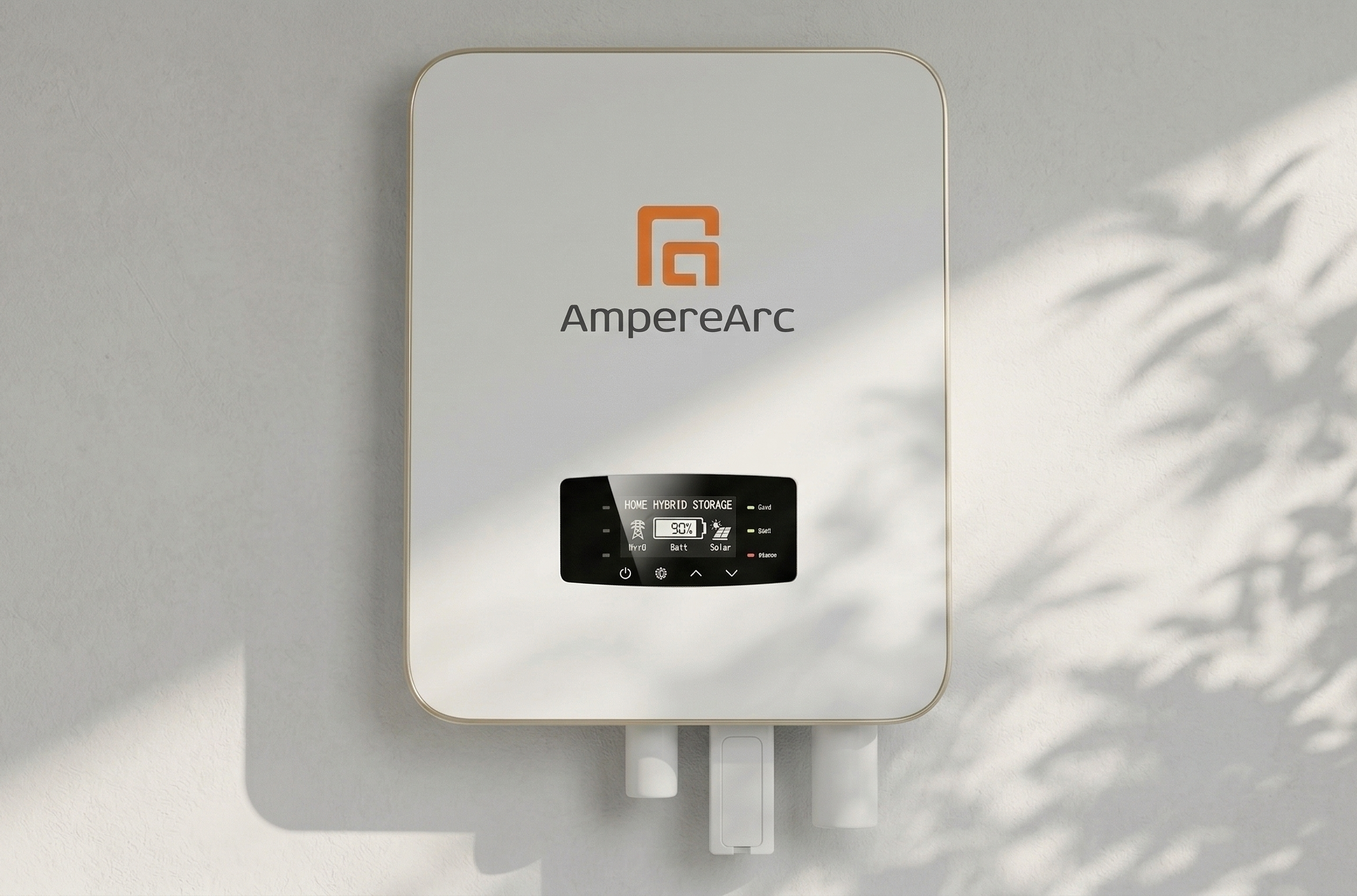
The inverter decides what happens in the first few milliseconds after the grid goes. Ours holds solar, battery and grid on one single-phase supply. On a three-phase building it serves one phase, and the survey decides which circuits belong on it.
An inverter is only as good as the DC work either side of it. String layout, isolation, earthing and the protection settings are drawn by the team that fits them, and the settings record leaves the site with you rather than staying on our laptop.
Design, supply, installation and commissioning for battery storage, solar and EV charging — grid application and panel work included.
Direct integration with AmpereArc storage and inverters
Built to order
A panel board is not something you take off a shelf. It is a schedule — an incomer, a way list, a control sequence — turned into copper, steel and labelled terminals. We build to the schedule you issue, or draw one with you first.
Nothing below is a specification, because every board leaves the shop different. These are the bands the shop works within; the final ratings are fixed against your drawings before manufacture starts.
We do not publish type-test references we cannot hand over. Ask, and we will send what exists for the assembly you are ordering.
Main switchboards and sub-boards for buildings, plant rooms and site supplies. Built around the schedule you issue: incomer, ways, phase allocation and spare capacity all fixed before a hole is punched.
Manual and automatic transfer between grid, generator and battery. Mechanical interlocking is fitted as standard, so the two sources cannot be closed together even if the control logic is wrong.
String combiners and the DC and AC protection either side of an array. Sized to the string layout the designer issues rather than to a stock way count, so nothing is left blanked off or doubled up.
Plant, pump and motor control assemblies, built to a control philosophy you supply or one we draw with you. Wired, numbered and tested on the bench so commissioning is a check, not a rebuild.
The board is built in our own workshop and energised by our own team. That removes the usual argument: the assembly on site is the assembly on the drawing, and there is no second party to point at when it is not.
Design, supply, installation and commissioning for battery storage, solar and EV charging — grid application and panel work included.
Supplied within systems
The charger is rarely the difficult part. The supply behind it is: what else is drawing at six in the evening, and whether the incomer can carry another 22 kW when every bay is occupied.
Charging output
7kW
A home or a single bay that should charge on solar surplus before it charges on the grid.
Charging output
11kW
A three-phase supply where the car has to charge faster without the main fuse becoming the limit.
Charging output
22kW
Car parks, workplaces and fleet yards where two cars share one supply between them.
These units are quoted, installed and commissioned as part of a system rather than sold on their own, and none of them has been photographed yet — the specification pages carry figures, not pictures. Ask for the datasheets with your enquiry and we will send the ones that apply to your site.
Chargers are quoted with the supply behind them. Load management, cable routes, groundworks and the back office are part of the same job rather than a follow-on trade booked after the unit arrives.
Design, supply, installation and commissioning for battery storage, solar and EV charging — grid application and panel work included.
EV charging scheduled against surplus generation
Supplied within systems
You cannot tune what you cannot see. A bi-directional meter at the incomer says what came in and what went out; the logger reads the inverters, meters and BMS behind it and sends the lot on.
What it measures
Import · export · generation
The reading at the incomer: what came in, what went back out, and how much of it you generated.
What it reads
Inverter · meter · BMS
Everything behind the meter — inverters, meters and battery BMS — read on one gateway and forwarded.
These units are quoted, installed and commissioned as part of a system rather than sold on their own, and none of them has been photographed yet — the specification pages carry figures, not pictures. Ask for the datasheets with your enquiry and we will send the ones that apply to your site.
Metering is fitted, read and proved at commissioning rather than left at its defaults. Thresholds are set on site against what the system actually does, and the portal accounts are named before we leave.
Design, supply, installation and commissioning for battery storage, solar and EV charging — grid application and panel work included.
Battery-backed comms, sized with the storage team
The incoming supply, the loads that matter and what has to stay on when the grid goes — that is enough for us to come back with a system, a bill of materials and a price. The hardware on this page and the team that installs it are the same company, which keeps the warranty and the fault-finding in one place instead of between two.
Design, supply, installation and commissioning for battery storage, solar and EV charging — grid application and panel work included.
Structured cabling, Wi-Fi design and managed switching for offices and homes — surveyed, certified and monitored.
Lighting, climate, blinds, security and energy on one system — designed at first fix, controlled locally.